Tuesday, May 29, 2012

Futura Architect Wicky

This semester's studio assignment was the good old ABC's with a twist.  From day one, we were studying the Futura font (unfortunately not available in blogger . . . ) as first a geometrical image, and then as a shape from which to make extrusions, then buildings.  It has sparked an interest for me (though some of my classmates might disagree) with letterform/typology.  I am currently reading a book about fonts called "Just My Type" and taking a 5-session letterpress class, which ends tonight.
On the first day, we were each given two letters (mine were D and A) and the assignment of learning their geometry and making the two letters merge together in a way that makes a whole new shape where the original letters are hopefully less recognizable.  We then extruded them 4" and thus began the great modeling session of our semester.
Over the following few weeks, we each made new models where three letters (mine were D, A, and F) were each extruded 10" in three different directions, the later models having the letters at different, non-orthogonal angles, the last one even morphing in size.  Each of these models was a section model, with the middle section cut covered in black paper, to make the new shapes that were created by the intersecting letters really stand out.
the first, most legible model


the second, craziest-and-hardest-to-build, model

the third model, where each of the letters are getting smaller
or bigger, from one side to the other.
What we learned throughout these first few weeks was more than just a study of geometry, but a study of patience, spending many (many) hours poring over bits of paper at our desks and finding the state-of-mind necessary to make each cut and each glueing more precise.
Jeff Kipnis, in his sea of letters
Even though these were the first real study of the semester, when we brought them out at our final review, Jeff Kipnis thought they were the most compelling work of the series.
To be continued . . . .

Sunday, March 25, 2012

Studying the Reliance Building

This semester at UIC, my friend Lauren and I have been doing a research project on the Reliance Building for our Tech class.  The building is very different from all other buildings being studied by our peers, which include the Mercedez Benz Museum by UN Studio, the IAC building by Frank Gehry, and Eberswalde Library by Herzog and deMeuron (sorry I couldn't find a good website for this one, but please look it up!).
Lauren, finding some old info
on the Reliance Building
The Reliance Building, unlike all of these, is over 100 years old, and in Chicago, which meant that Lauren and I got to be more hands-on than any of the other groups in learning about our building.  We went to the Art Institute Library to play history detectives of sorts, and looked through lots of old documents about the building, both from when it was first built and when it was restored in the 1990's.  We also got to interview Gunny Harboe, of Harboe and Assoc., who headed the restoration project.  He took his lunch hour one day to show us a whole slideshow and answer all of our questions about the facade system.  It was a really great opportunity.
The model we're planning to build
of the Reliance, in Rhino.
Also, since it is right here in downtown Chicago, Lauren and I went right in and asked if we could look around on the upper floors, which Gunny had suggested we do.  It was restored to be a hotel in the 1990's, and it is now called the Hotel Burnham, after Daniel Burnham.  The original style of the upper floors, which started out as offices, has been kept; the doors all have frosted glass windows.


For Valentine's Day, I was treated to a night at the Hotel Burnham.  It's the second time I've gotten to play tourist in Chicago by staying at a hotel downtown.  I had dinner at the Atwood Cafe (named for Charles Atwood, who took over the design of the Reliance Building after Root passed away) and stayed in a historical suite on the 11th floor.  Here are some of the pictures I took while I was there. 
View across the street, to the Marshall Field's
(begrudgingly, Macy's) building at night.

view south, on State Street, at night
view north, on State Street, at night
view north, on State Street, in the morning


upper hallways, still looking like office building floors

the downstairs lobby, originally planned to show off
Hale's (the building owner's) own elevator design.


Sunday, March 11, 2012

A late post on London

Lloyd's of London
I started off 2012 with a trip to London to visit my friend Katie, who was working there for 3 months.  Her company had set her up in a flat that was incredibly close to 30 St. Mary Axe (more commonly known as "the gherkin") and Lloyds of London.  During my 5 day stay, most of which I spent wandering around, exploring on my own, these two buildings became my lighthouses of sorts; when I was feeling a little lost by the end of the day, I would spot one of these buildings just up the street and know that I was close to home.  It was pretty cool, also, the first morning I was there to walk out of Katie's flat and be practically assaulted by a building or two that I had read about in books and newspapers.  
            Since a good 2 months have passed since I got back from London, this post is going to be a broader overview of the trip than I may have given when it was all fresh in my mind.  No matter, it's still the highlights.  
blue doors on the houses
inside the Tower of London
            The first day of the trip, I stuck to historical sights: a tour at the Tower of London, where I admired the crown jewels and some turquoise doors - quite striking against the white and dark wood bracing of these traditional English houses.  After that, I took a tour of the Tower Bridge, then took a long walk back home over the London Bridge.  Once Katie got home from work, we had a quiet dinner at a place next to the gherkin - probably a madhouse at lunch, but completely empty at dinnertime, since it's more of a business district.  
Millenium Bridge (and St. Paul's cathedral) at night
          Day two was a lot of walking as well: I tried my luck at Spitalfield's market, and saw a few things that enticed me, although the one thing I wanted to buy had no vendor present from whom to buy it!  So much for my first souvenir!  On to St. Paul's cathedral, where I ventured up the first two sets of stairs (53 meters/376 steps up).  The bracing cold January winds deterred me from climbing up the remaining 150 steps or so for the view up at the top.  After warming myself back up in the lower level of St. Paul's, then enjoying a sandwich at Pret a Manger, I crossed the Millenium Bridge to check out the Tate Modern.  They had an exhibit of Gerhard Richter's work.  I wasn't familiar with his stuff before, but found a few pieces to be really compelling, especially the ones that were many panes of glass set up next to each other like dominos (terrible way to describe it - maybe I'll come back with a link).  On the way back over the Millenium Bridge in the evening, I suspect that I dropped one of my lovely mittens, so it has probably rested well into the Thames by now.  Farewell dear mitten.
Houses of Parliament and Big Ben
            The next day was sunny and bright - as would be the rest of my visit in London!  It was a perfect day to check out the Houses of Parliament,
the shadow of the
London Eye.
followed by a turn around the London Eye, which I had actually ridden back in 2001, the last time I was in London, to visit a high school friend who was spending the semester there.  My ride back in 2001 was on a dark and stormy night, so this one was much more agreeable, especially now that I had a much nicer camera.
Enjoying coffees in the cloisters
at Westminster Cathedral
            Back over the river, I toured around Westminster Abbey, recognizing some of it from seeing Kate and William's wedding back in April, and other parts from my architecture history classes.  Too bad you cannot take pictures inside the churches; my favorite parts were the ceilings in the small alcoves up in the front of the church, beyond the choir pews.  I was able to take a few pictures out in the cloisters, however, and again took advantage of a sunny scene.  
            After another sandwich (this time at EAT.) I took a walk up Regent Street to find Liberty of London, where I did 90% of my shopping for the whole trip.  Fabrics and scarves - maybe someday I'll use the fabric and do a post about it on my other blog.  
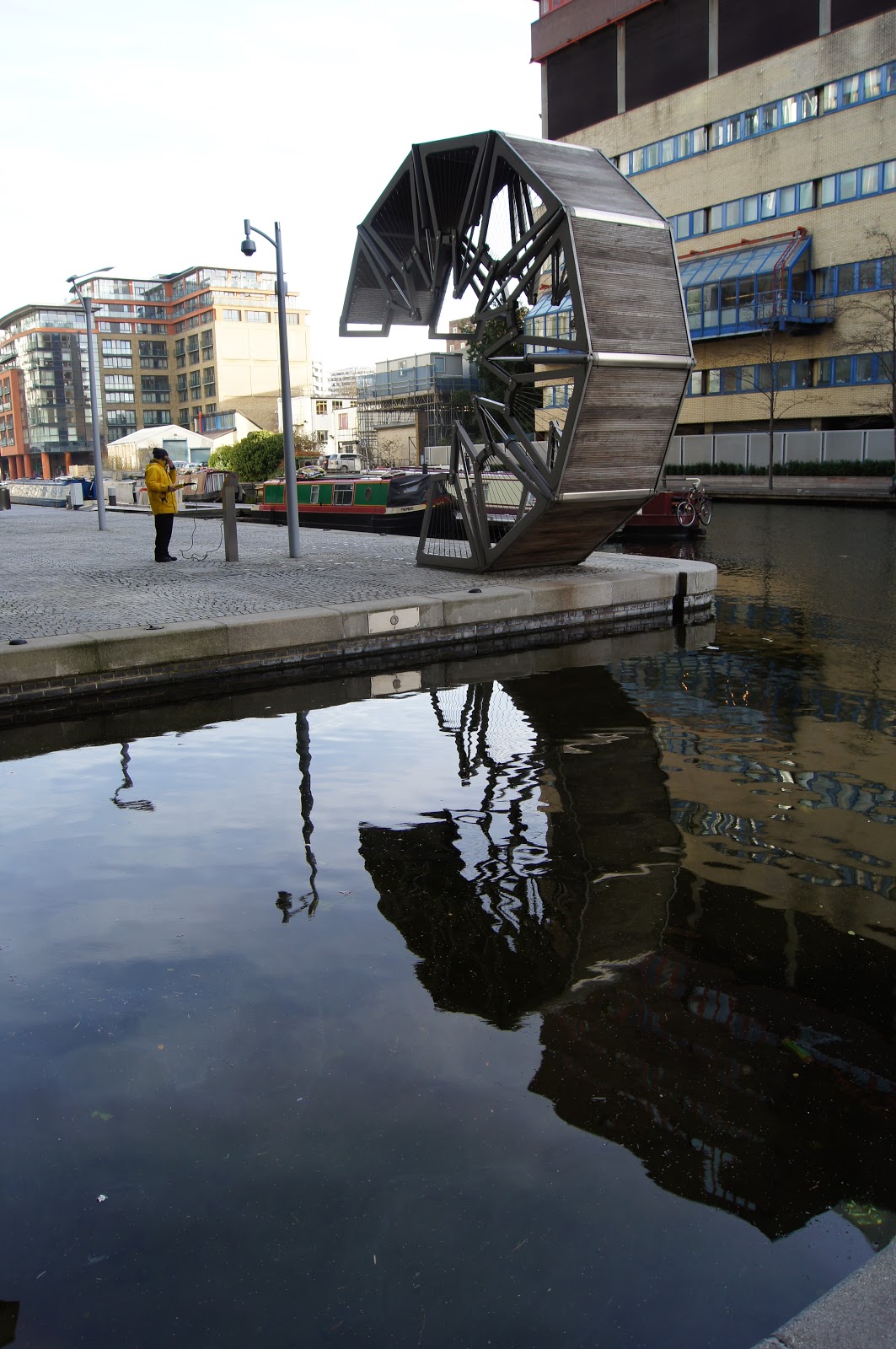
The Heatherwick Rolling Bridge, unrolled.
           The next day was an architectural pilgrimage of sorts.  I was off to find the Thomas Heatherwick rolling bridge, which I learned about back in 2005/2006, very recently after it had been built.  It's in a very quiet, unassuming area, and actually just crosses a very small dead-end canal (when the bridge is rolled up, you only need to walk an extra 30 yards or so).  It opens once a week, according to the website, but the technician who came to open it told me it's actually more like 3 times a week, more often even in the summer.  There was one other visitor who, like me, had come to see and photograph the bridge.  He is an architect from Columbia, and you can see him in the bottom picture of this bridge series.  I'm very late emailing him this picture, but hopefully he will understand how busy I've been, having gone through architecture school himself.  Anyway, the bridge was a fun little diversion, and since Alejandro and I enjoyed it so much the technician rolled it out a second time so that we could take more pictures.  It was a fun visit.


            After that, I took a long walk up through the northern part of the city, through Regent's Park, up to King's Cross Station, then south a little bit to meet Katie near her office.  We then hopped on the tube to the National Portrait Gallery, where we had high tea, then spent the rest of the evening looking at portraits, then more art at the National Gallery.  Both museums are open until 9 (I think it was 9) on Fridays, so we had a very cultural evening.  Then we went out to get a drink.  
Meat pie from Pie Minister
           Saturday, my last day in London, Katie and I walked over to the design museum, which had some fun exhibits.  They will be building a new building and moving soon, so I guess I'll have to go check it out again someday.  After that, we went to the Borough Market, where we enjoyed some meat pies for a late lunch.  For our final evening's activities, we saw Crazy For You at a theater in Covent Garden, then took the Hackney Wick bus home.  
            I fit quite a lot into a 5 day visit, especially considering I started back to school the day after I flew back to Chicago.  An exhausting but nice kick-off to my second semester!

Friday, December 23, 2011

A Scientific AutobiographyA Scientific Autobiography by Aldo Rossi

My rating: 4 of 5 stars


This book is less of an autobiography and more a collection of very poetic musings on architecture, written by this iconic Italian architect. I read this for my first semester studio class, but I found myself constantly reminded of why I was an English major in college: so many sentences that are beautiful not for what they describe but for what they themselves are . . . "the stasis of those timeless miracles, to tables set for eternity, drinks never consumed, things which are only themselves."


View all my reviews

Saturday, December 10, 2011

Scandinavian Odyssey, Part 6 (final)

Felt pins in a Finnish
design shop
After arriving in Helsinki and checking in at our possibly-too-luxurious Hotel Kamp, on the Esplanade, we drove our rental car over to the train station to drop it off with the agency.
This started our tour of die Jugendstil, at Eliel Saarinen's train station.  After poking around that building for a while, we slowly made our way back toward the hotel, stopping in at a few stores, then the outdoor market and the Saluhall (indoor food market), which we would frequent for the rest of the visit.
Helsinki Train Station.
            Our second day in Helsinki led us a little farther away from the center of town.  We signed up for a 3 hour "design tour" of the city, which brought us to a few spots nearby, like the Senate Square where the Helsinki Cathedral is, and some spots farther away, like the Temppeliaukio Church, which was one of my favorite stops on the tour.
copper ceiling at the Temppeliaukio Church
 
The church is excavated from the rock that covers the site.  It has very little ornament, mainly just a copper ceiling, which changes color some with the light.  The effect of the church is very calming, which is pretty impressive considering we were in there with a couple hundred other tourists, all taking photos at the same time.
The old Arabia Factory
            Our tour also brought us to the Arabia district, named after the dish design company, which also has a lot of new apartment complexes - each building suited toward the needs of a different demographic.  It was an incredibly hot day, but we got off the bus and walked around the apartment buildings, then into the old factory which has been converted into an indoor outlet shopping mall, for the Finnish design companies.  Mom and I finally got to buy some fun Fiskars scissors, which we had been eyeing throughout the trip.
Ice cream for dessert at the
Fazer cafe
            After the tour was over, we walked a few blocks south of our hotel to the Museum of Finnish Architecture, which had an interesting exhibit on Finnish schoolbuildings, and how their design has changed throughout the years.  If I had known then that I would be designing an elementary school for my first semester studio, I may have paid better attention!  Unfortunately, it was too hot in that building to concentrate on much of anything.  We also went to the Design Museum, which had a big exhibit on Kaj Franck, in honor of his 100th birthday.  Before making it back to our hotel, we stopped in at Stockmann's department store for a few knick-knacks and a great big salad for dinner at their cafeteria, then we had an ice cream sundae at the Fazer cafe, which was (unfortunately) right across the street from our hotel.
Uspenski Cathedral
            The next day, we checked out the Uspenski Cathedral, up on the hill on the eastern side of Helsinki.  Great views of the church and of the city.  We took a ferry out to Suomenlinna island, a fortress from the mid-18th century.  Again, the heat kept us from doing too much, but we did spend some time at the Ehrensvard Musuem, which told us the history of the fortress.
Helsinki Cathedral
Back on the mainland, we walked up the 53 steps to the Helsinki Cathedral, only to find out we were going in the side entrance, to see the very simple and calming interior.  That night, we had dinner at the Sea Horse restaurant, which was a recommendation from Mom's neighbor.  I finally had herring, and found it to be really not that bad!
the interior at the Cafe Jugend
            On our final full day in Helsinki, we had breakfast at the Cafe Jugend.  The interior of the building was designed by Lars Sonck, covered in Egyptian/Aztec-ian type moldings on the columns, etc., and great murals on the walls.  We spent quite a while checking out the whole place.
            Held up by the rain, we slowly made our way out to the flea market on the western side of the city, where we saw a lot of familiar dishware, and I got to sit in a red/blue chair, authenticity undetermined.
The National Museum of Finland,
with a watch-bear out front
             We poked around the outside of Finlandia Hall - the only guided tour that they give each week had been a day earlier, before we tried to sign up for it - then checked out the National Museum of Finland, then the Museum of Contemporary Art.  We had an early dinner of reindeer meat at the Lassipalatsi (1930's landmark glass palace), then back to the hotel to pack.
            It was a wonderful trip, one which I will continue to enjoy for quite a while, every time I wear a sweater or scarf that I bought, or look at the Dala horses I got in Sweden, etc.  I managed to keep a journal throughout the trip that I wrote in every night, without which this kind of itemized account would not have been possible.  And of course, I took many pictures, which I believe will inspire me throughout school and beyond.  What a great way to spend my last few weeks before starting my architecture program.
a view of Greenland, on our flight home

Sunday, December 4, 2011

A quick post on a school night.

Well, I've just about made it to the end of my first semester of architecture school at UIC.  Tomorrow is my final review for our semester-long project, which is culminating in the design of an elementary school for the fictional town (read: site model) of "Rossiville,"  the city my class has put together, inspired by the drawings of Aldo Rossi from his 1984 book, A Scientific Autobigraphy.
After I turn in one final paper on Tuesday, I will have some real, free time, and hopefully I will spend some of that time updating this blog here with some of the interesting things I've done or come across throughout the semester, including posting a few of my drawings etc.
In the meantime, I'm just going to post a few renderings of the school I've designed.
An exterior view of my school, which I call my Box School, in comparison with some other very non-box-ish schools I designed along the way.  Also, I liked to think of the roof as a box top being peeled up.  
Interior view - showing stairs and "bleacher" seating, as well as the undulating surfaces that we learned to build in Maya during the semester.
I'm keeping my fingers crossed for a good review tomorrow, and I'm very thankful that I'll be getting some sleep tonight, as most of my friends in studio will be up into the wee hours.  17 weeks has flown by!

Sunday, November 27, 2011

A quick quote

"The cumulative effect of architecture during the last two centuries has been like that of a general lobotomy performed on society at large, obliterating vast areas of social experience.  It is employed more and more as a preventive measure; an agency for peace, security and segregation which, by its very nature, limits the horizon of experience - reducing noise-transmission, differentiating movement patterns, suppressing smells, stemming vandalism, cutting down the accumulation of dirt, impeding the spread of disease, veiling embarrassment, closeting indecency and abolishing the unnecessary; incidentally reducing daily life to a private shadow-play.  But on the other side of this definition, there is surely another kind of architecture that would seek to give full play to the things that have been so carefully masked by its anti-type; an architecture arising out of the deep fascination that draws people towards others; an architecture that recognizes passion, carnality and sociality.  The matrix of connected rooms might well be an integral feature of such buildings."
-Robin Evans, "Figures, Doors and Passages," 1978

I just reread this while going over stuff for my Architectural History and Theory final exam.  It's from a long but interesting article that is more or less a history of the hallway.